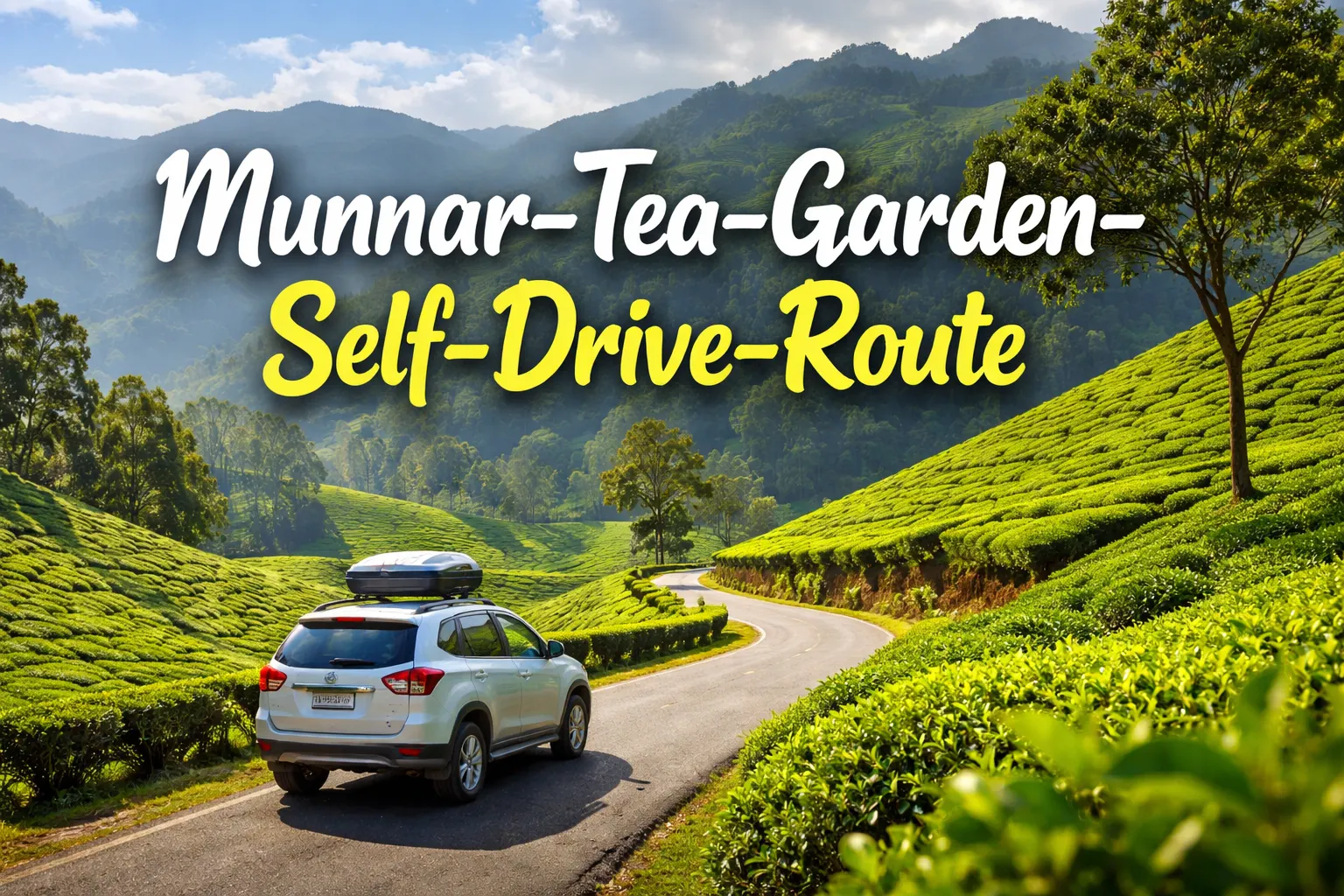
What does ₹2,200 actually buy you in Munnar? I found out the hard way on my fourth visit — a 45-minute rushed stop at Kolukkumalai, forty other tourists jostling for the same viewpoint, and a local operator who’d confidently called this a “complete tea garden experience.” It wasn’t. Not even close. That trip is the reason this self-drive guide exists.
That’s what pushed me to finally do the Munnar tea garden self-drive route properly. No guides. No fixed schedules. Just me, my rented Activa (₹500/day back then, it’s ₹650–750 now in 2026), and a Google Maps pin collection I’d been building for months.
And that decision? It changed everything about how I experience Munnar.
In 2026, this route matters more than ever. Entry fees have crept up, some estates now require prior permission, and there are new eco-zone regulations near Eravikulam that most travel blogs haven’t caught up with yet. I did two trips in 2024 and one in January 2026, so I’m giving you current, first-hand information — not recycled content from 2019.
Let’s get into it.
Why Self-Drive Is the Only Way to Do This Right
Here’s a question nobody asks but everyone should: why are all the best Munnar photos from people who weren’t on a group tour?
Because those rolling green hills, that silence between the tea rows, that golden-hour light catching the dew on leaves — none of that waits for a scheduled bus. It shows up when you decide to stop.
I’ve done Munnar with tour groups (twice — never again), with family in a hired cab (nice but still not free), and solo on a two-wheeler (multiple times). The self-drive wins every single time.
The main reasons:
- You can stop wherever you want, for however long you want
- Early morning starts are possible — and 6–8 AM in the tea gardens is genuinely magical
- You’re not sharing the “moment” with 30 others
- You save ₹800–1,500 per day vs hired guided tours
- You discover spots that aren’t on any operator’s itinerary
The roads around Munnar’s tea belt are genuinely manageable. Even if you’re not a seasoned mountain driver, SH17 and the stretch toward Top Station are well-maintained (mostly — I’ll be honest about the bad patches). A gearless scooter handles 90% of this route just fine.
Planning Your Munnar Self-Drive: Dates, Distance & Time
Best Time to Go
I’ve been in every season now, so let me give it to you straight.
October to February is peak and for good reason — clear skies, green carpets, cool weather. Expect ₹4,000–8,000/night for decent homestays during Christmas and New Year. Book 6–8 weeks in advance if you’re going in December. I checked rates in January 2026 and even mid-tier options were ₹3,500–4,200/night.
March to May is warmer, drier, and the tea bushes look a bit dusty. But hotels are cheaper (₹1,800–2,500/night easily), roads are emptier, and you get these gorgeous clear-sky mountain views that the misty season hides.
June to September — this is my secret favourite. Monsoon Munnar is alive. Everything is shockingly green, waterfalls appear from nowhere, and the roads are mostly quiet. Yes, it rains. Yes, some routes get tricky. But if you’re on a scooter with a good raincoat and zero agenda? Absolute bliss. Stayed at a homestay for ₹1,200/night in July 2024. The owner made me fresh ginger chai every morning.
Distance & Time Reality Check
The full loop I recommend — Munnar town → Mattupetty → Top Station → Kolukkumalai → Chinnakanal → back to Munnar — is roughly 110–130 km total depending on your exact stops.
On a scooter, with stops, chai breaks, and photography? Plan for two full days comfortably, or one long, exhausting but rewarding day if you’re experienced and start at 6 AM.
Don’t rush it. I made that mistake on visit two. Never again.
The Full Route Map: Stop by Stop Breakdown
Here’s the route I personally follow now. This is refined from 8+ trips.
Day 1: Munnar Town → Mattupetty → Kundala → Top Station
| Stop | Distance from Munnar | Approx. Time Needed |
|---|---|---|
| Munnar Town (base) | — | Morning start |
| KDHP Tea Museum | 1.5 km | 45–60 min |
| Mattupetty Dam & Estate | 13 km | 1.5–2 hours |
| Echo Point | 15 km | 30 min |
| Kundala Lake | 20 km | 45 min |
| Top Station | 32 km | 1–1.5 hours (stay for sunset) |
Day 2: Munnar Town → Kolukkumalai → Chinnakanal → Rajamala
| Stop | Distance from Munnar | Approx. Time Needed |
|---|---|---|
| Chinnakanal Waterfalls | 25 km | 45 min |
| Kolukkumalai Tea Estate | 40 km (via Suryanelli) | 2.5–3 hours (includes jeep ride) |
| Rajamala / Eravikulam NP | 12 km from Munnar | 2 hours (book online in advance!) |
| Lockhart Tea Estate area | 8 km | Free roadside stop |
The road to Kolukkumalai is the only genuinely rough section. After the Suryanelli junction, it’s all jeep territory — you park your scooter and hire a local jeep (₹250–350/person shared, ₹1,400–1,800 for full jeep in 2026). Non-negotiable. But absolutely worth it.
Top Tea Estate Stops — What to Expect & What to Pay
1. KDHP Tea Museum, Nallathanni
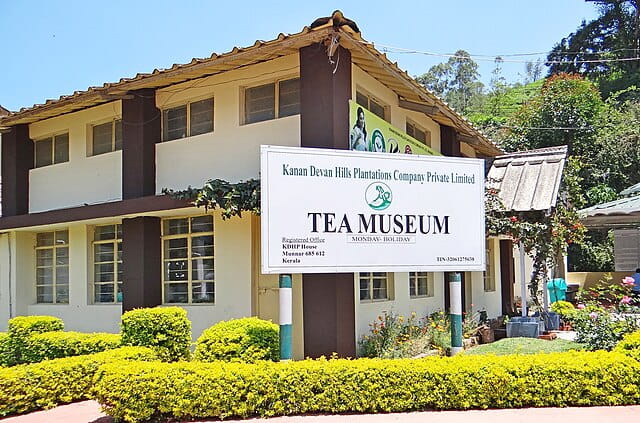
This is operated by Kanan Devan Hills Plantations — one of the largest and most responsible tea companies in the region. The museum is genuinely educational, not a tourist trap. I’ve sent my parents here when they visited; they loved it.
- Entry fee (2026): ₹200/adult, ₹100/child
- Includes: A small factory tour and tea tasting session
- Time needed: 45–60 minutes
- My tip: Go on a weekday morning. Weekends get crowded and the factory floor gets noisy.
Pros:
- Official, well-maintained
- Staff are actually knowledgeable
- Tea shop at the end with good prices (bought 500g CTC for ₹280)
Cons:
- A bit scripted — same tour every time
- Photography restricted inside factory
- No “walking among the bushes” experience
2. Mattupetty Estate (KDHP-managed)
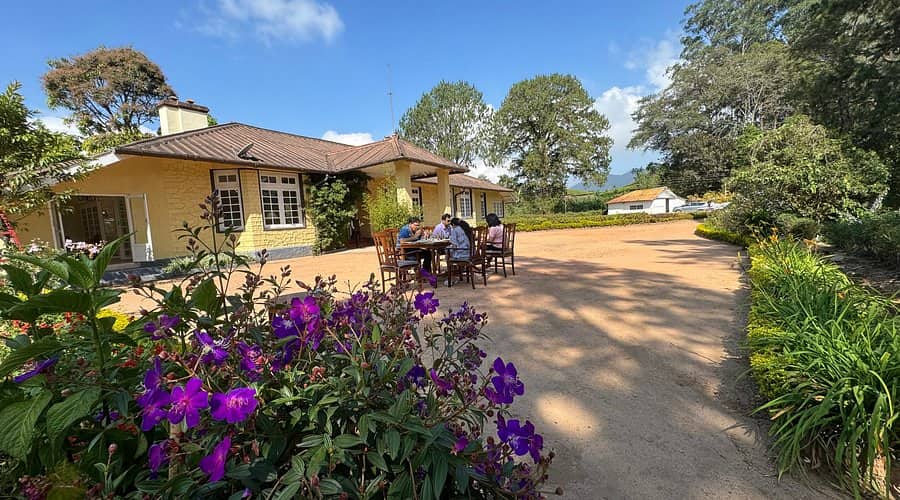
The drive here is already beautiful — winding roads, tea on both sides, occasional bison sightings (seriously, I’ve seen Gaur here three times). The estate itself isn’t a tourist attraction per se, but the road through it is the attraction.
Stop anywhere along the Mattupetty stretch, park the scooter on the side, and just walk in a little between the rows. Nobody stops you. Workers often wave. Early morning, you’ll sometimes see the plucking teams — predominantly women — with their baskets, and it’s one of the most humbling, beautiful sights in all of South India.
My note on responsibility: Please don’t pick the leaves, don’t trample the plants, and if you photograph workers, always ask first. These are people’s livelihoods, not props.
3. Kolukkumalai — The Highest Tea Estate in the World
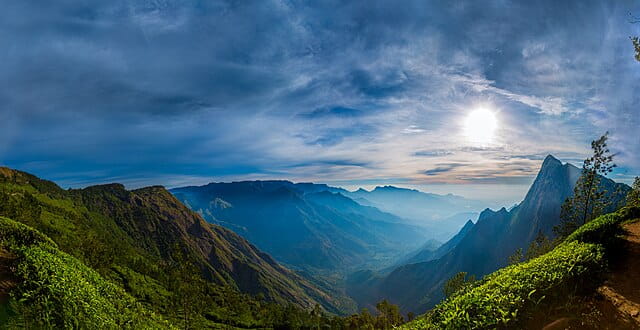
At 7,900 feet, this is the one that stops your breath. Literally — the altitude catches you off-guard if you’re from Delhi like me.
- Jeep from base: ₹250–350/person (shared) | ₹1,400–1,800 (private jeep, 2026 rates)
- Factory entry: ₹100/person
- Tea tasting: ₹50 extra, totally worth it
- Best time: Sunrise. I reached the top at 6:15 AM in January 2026. The cloud layer below the estate was surreal.
Pros:
- Most dramatic landscape of any tea garden in India
- The old colonial-era factory is charming and authentic
- Tea here has a distinct flavour — cleaner, slightly floral
Cons:
- Rough jeep ride isn’t for everyone (back pain warning)
- Gets crowded by 9–10 AM, especially on weekends
- Slightly commercialised in recent years — more stalls, more noise
Where to Stay Along or Near the Route
I’ve slept in everything from a ₹700/night dormitory in Munnar town to a ₹7,000/night tea bungalow near Devikulam. Here’s my honest take.
Budget (₹1,000–2,000/night): Homestays near Munnar bazaar or along Chinnakanal Road are your best bet. In January 2026, I stayed at a family-run homestay on the Chinnakanal stretch for ₹1,500/night including breakfast. The owner, Rajan uncle, gave me homemade pickles and knew every shortcut on the route.
Mid-range (₹2,500–4,500/night): There are several nice tea estate bungalows and resorts near Mattupetty and Devikulam that sit inside or adjacent to the tea gardens. Worth the extra spend once — just to wake up surrounded by green. I paid ₹3,200/night at one such property in March 2024.
Splurge (₹6,000+/night): Windermere Estate and a few KDHP heritage bungalows are genuinely world-class. Not my usual style but I did treat myself once. It’s the kind of place that makes you understand why the British colonials loved this hill so much — before I quickly remind myself of the more complicated history that built it.
What to Eat, When to Eat, and Where
Don’t let anyone tell you Munnar has bad food. It has misunderstood food.
Skip the tourist-facing restaurants near the main bazaar that serve “North Indian thali” for ₹350 — that’s tourist tax in edible form.
What I actually eat:
- Morning: Tea and parippu vada (lentil fritters) from any small tea stall along the route. ₹30–50 for a filling combo.
- Lunch: Ask your homestay host the night before to pack a lunch box — most will for ₹120–150. Rice, dal, a sabzi, pickle, papad. Eaten at a hilltop stop? Unbeatable.
- Evening snack: Freshly brewed estate tea from any factory stop — usually free or ₹30.
- Dinner: Simple Kerala meals. Appam and stew is my go-to. A good local restaurant near Munnar town will charge ₹150–220 for this.
And please, please drink the freshly brewed tea from the estates. Not the packaged stuff on the way out. Stand there, hold the glass, sip slowly. That’s the whole point.
Insider Tips Only Repeat Visitors Know
These took me eight trips to figure out. You’re welcome.
- The Lockhart Gap road (to Top Station) is better anti-clockwise. Go to Top Station first, spend 30 min, then cruise back slowly with the valley on your left. The views hit differently.
- Start Kolukkumalai by 5:00 AM. The jeep guys at the base will take you that early — they’re usually there by 4:45. Sunrise from the top in January is among the top five natural moments of my life.
- Mattupetty has free grazing bison near the dam road around 6–8 AM. Don’t chase them. Stop 15–20 meters away. They’re massive, peaceful, and absolutely wild.
- Eravikulam National Park (Rajamala) now requires advance online booking — they’ve capped daily entries. I showed up unbooked in late 2024 and was turned away. Entry is ₹450/adult (₹130 for kids) as of early 2026. Book via the Kerala Forest Department website at least 2–3 days ahead.
- The tea sold inside estates is fresher and cheaper than the souvenir shops. I bought 1 kg of high-grown orthodox tea from a factory shop for ₹480 in January 2026. The same branded stuff outside? ₹800+.
- Mobile data dies near Top Station and Kolukkumalai. Download your offline Google Maps beforehand. BSNL works slightly better than Jio in these patches, weirdly.
- Scooter rental: avoid the shops right at the bus stand. Walk 200m inward and you’ll find better-maintained bikes for ₹50–100 less per day. Always check brakes yourself before leaving.
2026 Updates: Rules, Fees & What’s Changed
A few things have genuinely shifted since the pre-2024 guides you’ll find everywhere:
- Eravikulam NP: Online booking mandatory, capped daily entry, ₹450/adult. A lot of old blogs say just “turn up.” Don’t.
- Plastic ban enforcement: Strictly no plastic bags or single-use plastic inside tea estates. Carry a cloth bag — I bought a nice jute one in Munnar for ₹40.
- Kolukkumalai entry permission: As of 2026, there’s a small registry at the base where you log your name and number. It’s free and quick, but don’t skip it — they’ve started turning away people who bypass it.
- Scooter rates: Up from ₹400–500 (pre-2022) to ₹650–750/day for a good Activa. Electric scooters are now available at a couple of rental places (₹850/day) — range is fine for the route.
- Top Station viewpoint: A small ₹50 “maintenance fee” has been informally collected since mid-2024. It’s not official, but locals use it to maintain the pathway and keep the area clean. I pay it happily.
Prices can change — I personally checked and paid these in January–February 2026. Confirm at the spot.
Read Also: Packing List for Munnar Tea Garden Trip (2026 Guide)
FAQs
Q: Can a beginner drive a scooter on the Munnar tea garden route?
A: Yes, mostly. The main roads (SH17, Mattupetty Road, Top Station Road) are manageable for anyone comfortable on a gearless scooter. The only exception is the rough gravel track to Kolukkumalai — you don’t drive that anyway; jeeps take over. I’d say 7/10 confidence on a scooter is enough.
Q: Is it safe to self-drive solo in Munnar?
A: Absolutely. I’ve done it solo multiple times, including as a solo traveller from Delhi with zero local contacts. The roads are generally safe, locals are friendly, and mobile signal is decent on most of the route. Just carry a physical backup map for the dead-zone stretches.
Q: How many days is ideal for the full self-drive tea route?
A: Two full days is the sweet spot. One day is possible but you’ll feel rushed. Three days lets you breathe, explore side roads, and revisit your favourite spots — that’s my preferred mode now.
Q: What’s the total estimated budget for 2 days on this route?
A: Solo, budget mode — roughly ₹3,500–5,000 total including accommodation (₹1,200–1,500/night homestay), scooter (₹650–750/day), fuel (₹200–250), food (₹400–500/day), and estate entries (₹800–1,000 all together). Mid-range stretches to ₹7,000–9,000 easily.
Q: Is Munnar better than Ooty or Wayanad for tea garden experiences?
A: For tea estates specifically, Munnar wins outright — the scale, the variety of estates, the altitude range, and the factory access are unmatched in South India. Wayanad has beautiful nature but fewer tea-specific experiences. Ooty’s tea belt is smaller and more touristy. Darjeeling offers a different, equally compelling experience, but that’s a whole other trip.
Q: Can I enter tea estates freely or do I need permission?
A: Most estate roads are open to drive through. Entering the factory floors or organised garden tours requires paying the entry fee. Don’t just wander into workers’ sections — respect the workspace and ask if you’re unsure.
Q: What should I buy from the tea estates?
A: High-grown orthodox tea (whole leaf, not CTC) is what I always buy. Ask specifically for “single estate” or “high-grown” varieties — they’re more nuanced in flavour. A quality 500g pack runs ₹280–480 bought directly at factory shops.
Q: Are there ATMs along the route?
A: In Munnar town, yes — multiple. Beyond that? Almost nothing. Carry sufficient cash before you head out, especially for Kolukkumalai (jeeps are cash only) and small estate entries.
Final Thoughts
Eight trips. One terrible guided tour that started it all. And now I genuinely can’t imagine experiencing Munnar any other way.
The Munnar tea garden self-drive route is not just a travel itinerary — it’s a kind of practice in slowing down. You stop when something catches your eye. You stay at an overlook until the light changes. You share a glass of tea with a planter who’s worked these rows for twenty years and who has more knowledge in one hand than every travel app combined.
That’s the thing about this place. Every time I come back, it teaches me something I missed on the last visit.
My honest advice? Don’t try to “complete” this route. Don’t tick boxes. Start early, drive slow, stop often, and spend a little extra at the estates directly — it supports the workers and the land that makes this whole experience possible.
And if you’re planning a trip? Drop a comment below — happy to help you plan it down to the chai stop. Seriously.

Sunil Singh is a dedicated travel content writer and the founder of MunnarTeaGardens.in. He specializes in creating comprehensive, user-friendly guides on Munnar’s tea gardens, hill stations, and Kerala tourism. Drawing from the latest tourism trends, official sources, and visitor experiences, Sunil helps thousands of travelers plan safe and rewarding trips every year.