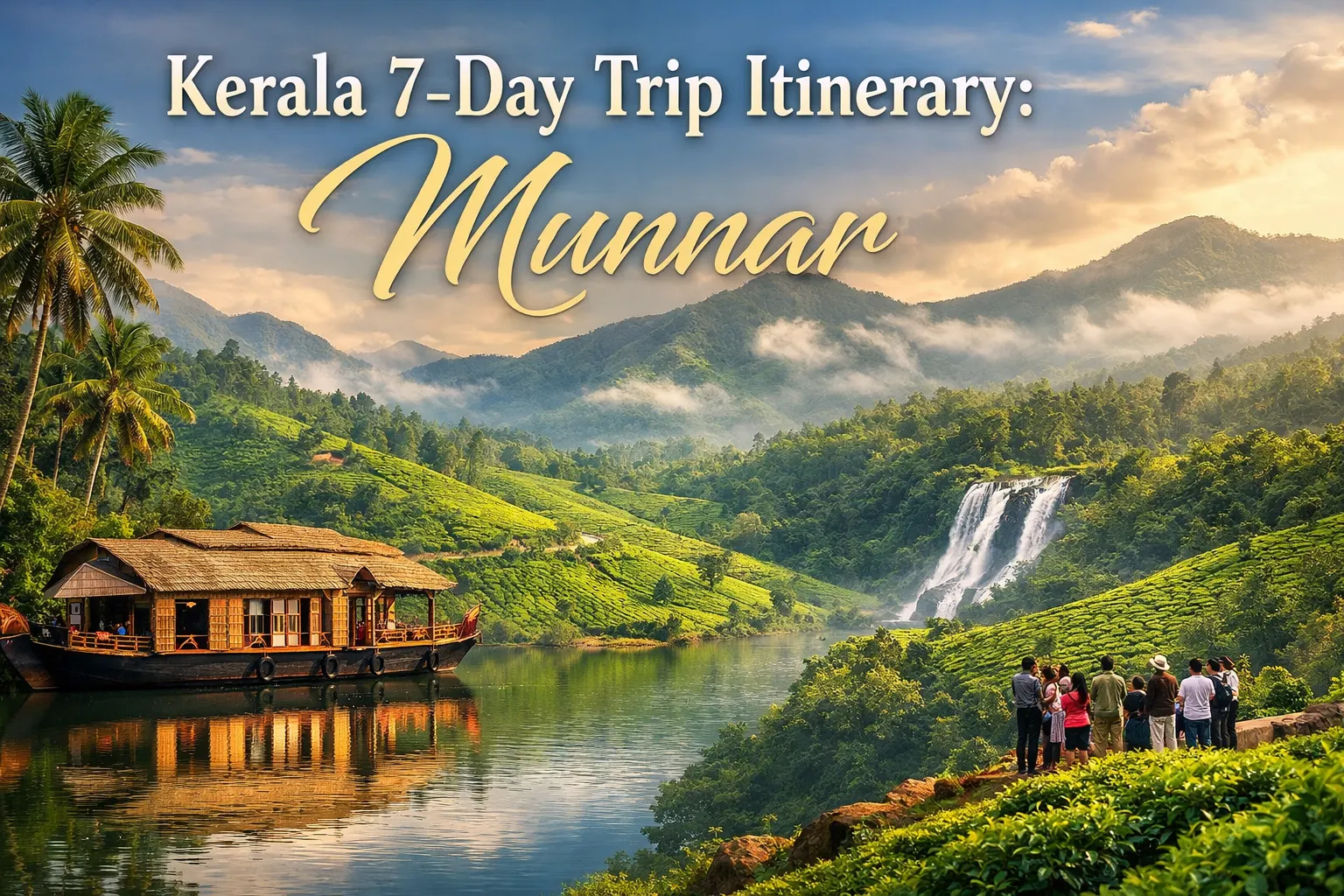
Imagine waking up inside a wooden houseboat, the backwaters completely still, the air smelling faintly of coconut palms and morning mist. Or sipping the freshest cup of chai you’ve ever had while surrounded by rolling tea estates that stretch so far they blur into the clouds. That’s Kerala — and once you go, you understand why they call it God’s Own Country.
But here’s the honest truth: Kerala is incredibly easy to do badly. Too many tourists spend half their trip stuck in transit, picking the wrong accommodation, or skipping hidden gems because no one told them about it. This itinerary fixes all of that.
This is your complete, no-fluff 7-day Kerala travel guide for 2026 — covering the hill station magic of Munnar, the wildlife thrills of Thekkady, the iconic backwaters of Alleppey, and the laid-back beach vibes of Kovalam. Whether you’re travelling solo, as a couple, or with family, this route is tried, tested, and genuinely enjoyable.
Is 7 Days Enough for Kerala?
Seven days is the sweet spot for first-time Kerala visitors. It’s enough time to experience four completely different landscapes — hills, forests, backwaters, and beaches — without feeling like you’re living out of a suitcase every night.
Kerala Tourism data consistently places it among India’s top domestic and international travel destinations, drawing over 1.5 crore tourists annually. The state’s tourism infrastructure is mature, English is widely spoken, and food (oh, the food) is something you’ll think about for years.
The route in this guide moves south to north in terms of altitude — hills first, then lakes, then sea — which also means your travel days get progressively easier as the week goes on. Practical? Very.
Kerala 7-Day Itinerary at a Glance
| Day | Destination | Highlights |
|---|---|---|
| Day 1 | Arrival + Munnar | Tea estates, Mattupetty Dam |
| Day 2 | Munnar | Eravikulam NP, Attukal Waterfalls |
| Day 3 | Munnar → Thekkady | Spice plantations, Periyar Lake |
| Day 4 | Thekkady | Wildlife safari, cultural show |
| Day 5 | Thekkady → Alleppey | Houseboat check-in, backwater cruise |
| Day 6 | Alleppey → Kovalam | Beach time, Lighthouse Hill |
| Day 7 | Kovalam + Departure | Vizhinjam, Padmanabhaswamy (Trivandrum) |
Day 1: Arrival in Cochin — Drive to Munnar
Getting to Munnar from Kochi Airport
Most travellers fly into Cochin International Airport (COK), which is about 110 km from Munnar. The drive takes roughly 3.5 to 4 hours depending on traffic, and it’s one of the most scenic road journeys in India.
Book a private taxi in advance (budget around ₹2,500–₹3,500 one way). Avoid sharing a cab unless you’re on an extremely tight budget — the mountain roads in the last hour require a comfortable, reliable vehicle, and you’ll want to stop for photos.
Pro tip: Fly in by noon if possible. This gives you time to settle into your Munnar hotel before sunset, which you absolutely don’t want to miss over the tea hills.
First Evening in Munnar
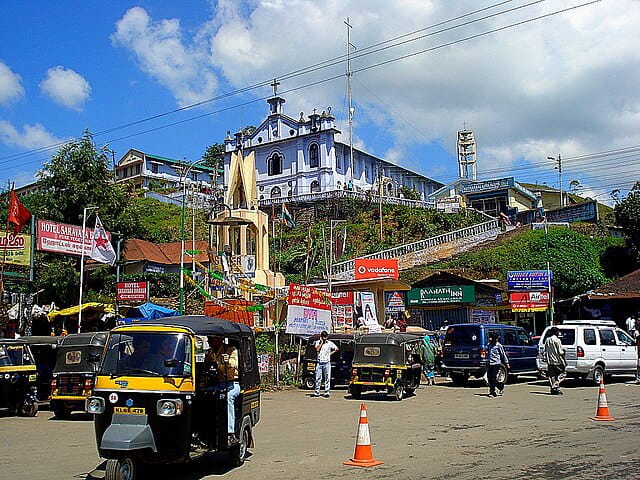
Don’t try to pack too much on arrival day. Instead, check in, freshen up, and take a slow stroll through Munnar town. It’s small, chaotic in a charming way, and crammed with shops selling cardamom, homemade chocolates, and spice mixes.
Grab dinner at a local Kerala restaurant — try the fish curry with appam or puttu and kadala curry. Both are classics, both cost under ₹150 a plate, and both will set the tone for a week of excellent eating.
Day 2: Exploring Munnar — Tea, Waterfalls & Wildlife
Morning: Eravikulam National Park
Wake up early. Eravikulam National Park opens at 7:30 AM and is home to the endangered Nilgiri Tahr — a mountain goat species you’ll only find in the Western Ghats. The rolling grasslands and mist-covered peaks here look almost otherworldly.
Entry fee is around ₹125 for Indian nationals and ₹470 for foreign tourists (prices updated for 2026). The park is accessible via a government bus from the ticket counter — private vehicles are not allowed inside.
Important note: Eravikulam closes every year from February to March for the calving season of the Nilgiri Tahr. Always check the official Kerala Forest Department website before visiting.
Afternoon: Tea Museum & TATA Tea Estates
The Munnar Tea Museum, run by the Kanan Devan Hills Plantations Company (part of the Tata Group), is genuinely fascinating. You’ll learn how Munnar transformed from dense forest to one of the largest tea-producing regions in India — a story that dates back to the 1880s under British colonial cultivation.
The guided tea-tasting session alone is worth the ₹150 entry fee. You’ll likely never look at a cup of tea the same way again.
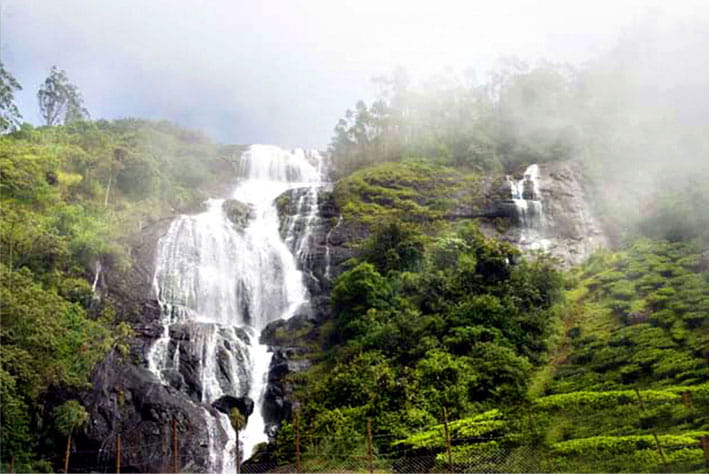
Evening: Attukal Waterfall
About 9 km from Munnar town, Attukal Waterfall is best visited in the late afternoon when the light turns golden and the crowds thin out. It’s a short walk from the roadside parking. Bring a light jacket — the temperature in Munnar regularly dips below 15°C even in summer, and the mist near waterfalls makes it feel cooler.
Day 3: Munnar to Thekkady — Spice Gardens & Periyar Lake
The Drive: One of Kerala’s Best Road Trips
The 65 km drive from Munnar to Thekkady takes about 2.5 to 3 hours but is genuinely one of the highlights of the trip. The road winds through cardamom plantations, rubber estates, and small tribal villages. Stop wherever catches your eye — there are no rules here.
Tip: Leave Munnar by 9 AM so you reach Thekkady by noon and have a full afternoon free.
Spice Plantation Tour
Thekkady is the spice capital of Kerala. Nearly every hotel here can arrange a guided spice plantation tour, or you can join one independently for around ₹300–₹500 per person. You’ll walk through rows of cardamom, pepper, nutmeg, cinnamon, and vanilla, with a knowledgeable guide explaining the cultivation process.
This isn’t a tourist gimmick — these are working plantations, and the knowledge you pick up here changes how you cook when you get home.
Afternoon: Periyar Lake Boat Ride
Periyar National Park surrounds a man-made reservoir created in 1895 by the British. The lake boat ride (₹300–₹500 per person for a 1.5-hour ride) is the best way to spot wildlife — wild elephants, gaur, sambhar deer, and various bird species regularly come to the water’s edge.
Book boat rides directly at the Kerala Tourism Development Corporation (KTDC) counter at the lake. Don’t buy tickets from touts outside — it’s overpriced and unnecessary.
Day 4: Full Day in Thekkady — Jungle, Culture & Fire
Morning: Bamboo Rafting or Tiger Trail
For the more adventurous traveller, Bamboo Rafting through the Periyar Tiger Reserve is an extraordinary experience. You float through the core forest zone on a bamboo raft with a tribal guide, with almost guaranteed wildlife sightings at dawn. It costs around ₹1,500–₹2,000 per person and must be booked at least a day in advance through the Forest Department.
The Tiger Trail is a two-day overnight trek through the reserve — only for serious trekkers, but worth mentioning if you’re extending your trip.
Evening: Kathakali Performance
No Kerala trip is complete without watching a Kathakali performance — the classical dance-drama that has been performed in Kerala for over 500 years. In Thekkady, the Mudra Cultural Centre and several other venues offer nightly shows starting around 6 PM.
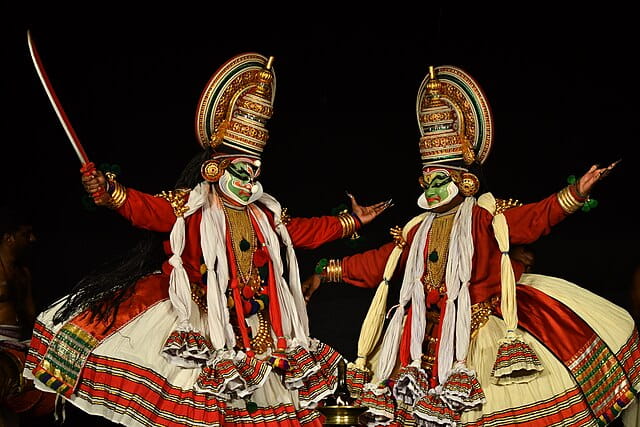
Arrive 45 minutes early to watch the performers apply their elaborate makeup. That pre-show ritual is as mesmerising as the performance itself. Ticket prices range from ₹200 to ₹350 depending on the venue.
Day 5: Thekkady to Alleppey — Into the Backwaters
The Houseboat Experience: What to Know
Alleppey (Alappuzha) is the houseboat capital of India, and spending a night on the Kerala backwaters is one of those travel experiences that legitimately lives up to the hype.
The drive from Thekkady to Alleppey is about 130 km, taking roughly 3 to 3.5 hours. Aim to arrive by 12:30 PM — houseboats check in at 1 PM and check out the next morning at 9 AM.
Houseboat costs vary enormously:
- Budget option: ₹6,000–₹8,000 per night (basic one-bedroom)
- Mid-range: ₹10,000–₹15,000 per night (AC, two bedrooms, decent meals included)
- Luxury: ₹20,000–₹40,000 per night (premium fittings, gourmet food, private deck)
For couples, the mid-range option is the sweet spot. For families, book two-bedroom houseboats — they’re better value and more comfortable.
What Life on the Backwaters Actually Looks Like
Your cook prepares all three meals on board using fresh local ingredients bought from village markets along the route. Lunch usually features karimeen pollichathu (pearl spot fish wrapped in banana leaf), a dish that’s as Kerala as it gets.
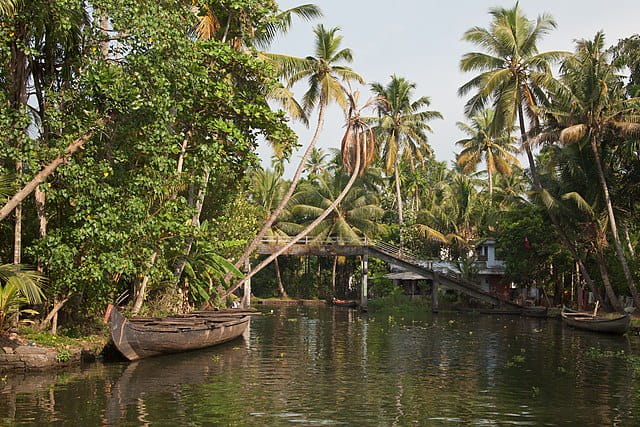
You’ll drift through narrow canals, past Chinese fishing nets, local churches, and children playing on the banks. It’s slow, quiet, and genuinely therapeutic. Put your phone away as much as you can.
Day 6: Alleppey to Kovalam — Kerala’s Most Famous Beach
Making the Move to the Coast
After checking out of your houseboat by 9 AM, it’s a 3 to 3.5 hour drive south to Kovalam, Kerala’s most iconic beach destination, located just 16 km from Thiruvananthapuram (Trivandrum).
Kovalam has three crescent-shaped beaches — Lighthouse Beach, Hawah Beach, and Samudra Beach. Lighthouse Beach is the main one, named after the working lighthouse on the rocky promontory at its southern end.
Afternoon and Evening at Kovalam
Check in, drop your bags, and walk straight to the sea. After five days of hills, forests, and backwaters, the sight of the Arabian Sea is almost startling in its beauty.
The Lighthouse Hill walk at sunset is unmissable. Climb the rocky path alongside the lighthouse for panoramic views of the entire coastline. It costs ₹25 to climb the lighthouse itself — do it.
For dinner, the row of rooftop restaurants along Lighthouse Beach all serve the same broad menu of fresh seafood, Kerala curries, and continental options. Coral Reef Restaurant and Fusion Restaurant are consistent favourites among returning visitors.
Day 7: Kovalam, Trivandrum Sightseeing & Departure
Morning: Vizhinjam Mosque and Rock Cut Cave Temple
The fishing village of Vizhinjam, just 2 km from Kovalam, is often overlooked. It’s home to one of Kerala’s oldest rock-cut cave temples, dating to the 8th century Ay dynasty. The temple is carved directly into a cliff face and remains an active place of worship.
The area is also interesting because of the ongoing Vizhinjam International Seaport development — a major infrastructure project that’s been transforming the coastline and is set to become one of India’s largest deep-water ports.
Mid-Morning: Padmanabhaswamy Temple (Trivandrum)
If you have a 2 PM or later flight, spend your morning at the Sree Padmanabhaswamy Temple in Trivandrum — one of the wealthiest and most architecturally stunning temples in India. The main deity (Lord Vishnu in reclining form) stretches across three doorways, which is extraordinary to witness.
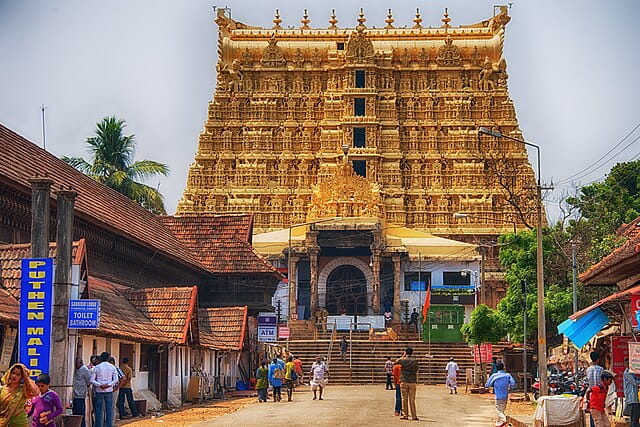
Note: Non-Hindus are not permitted inside the main sanctum. But even the outer courtyard and the seven-storey Gopuram (temple tower) are architecturally magnificent.
Dress code is strict — men must wear dhoti or mundu, no trousers. Women must wear a saree or salwar kameez. Rentals are available outside the temple.
Kerala Trip Budget Breakdown (2026 Estimates)
| Category | Budget Traveller | Mid-Range | Premium |
|---|---|---|---|
| Accommodation (7 nights) | ₹7,000–₹12,000 | ₹18,000–₹30,000 | ₹50,000+ |
| Food (7 days) | ₹3,500–₹5,000 | ₹7,000–₹12,000 | ₹20,000+ |
| Transport (excl. flights) | ₹6,000–₹9,000 | ₹12,000–₹18,000 | ₹25,000+ |
| Houseboat (1 night) | ₹6,000–₹8,000 | ₹10,000–₹15,000 | ₹25,000+ |
| Entry fees & activities | ₹2,000–₹3,000 | ₹4,000–₹6,000 | ₹10,000+ |
| Total (per couple) | ~₹25,000 | ~₹50,000–₹80,000 | ₹1,30,000+ |
Flights to Kochi and back from major Indian cities typically range from ₹4,000–₹10,000 per person return, depending on how far in advance you book.
Best Time to Visit Kerala
Kerala can be visited year-round, but the experience changes dramatically by season.
October to February is peak season — pleasant weather, dry roads, and all attractions fully open. This is when Kerala is at its best, and also when it’s most crowded and most expensive.
March to May brings rising temperatures on the coast but remains comfortable in the hills. Eravikulam National Park reopens in April after the calving season closure.
June to September is monsoon season. Kerala’s monsoon is dramatic — the landscape turns an impossible shade of green, waterfalls are at their most powerful, and prices drop significantly. The backwaters and houseboat experience have a completely different, more atmospheric quality. However, some roads become difficult and outdoor activities are limited.
For most travellers, November to January offers the best overall experience.
Practical Tips for Kerala 2026
SIM Cards: Buy a local SIM at Kochi airport. Jio and Airtel both have good coverage across Kerala’s main tourist routes.
Languages: Malayalam is the local language, but English and Hindi are widely understood in tourist areas. A few Malayalam phrases (like nandi for “thank you”) go a long way.
Dress Modestly at Temples: Kerala has some of the most beautiful temples in India, and most require covered shoulders and legs for entry.
Carry Cash: Small towns, local restaurants, and village markets are still largely cash-based. Carry ₹5,000–₹10,000 in smaller notes at all times.
Tipping Culture: Tipping is not mandatory but appreciated. ₹100–₹200 for a day’s guide, ₹200–₹300 for the houseboat crew is appropriate.
Food Safety: Kerala’s restaurant food is generally very safe. Be slightly more cautious with street food if your stomach isn’t accustomed to spice levels.
Frequently Asked Questions
How many days are enough for Kerala?
Seven days is ideal for a first Kerala trip covering Munnar, Thekkady, Alleppey, and Kovalam. If you want to add Wayanad or Thrissur, plan for 9–10 days.
Is Kerala expensive to travel?
Kerala is mid-range on India’s travel spectrum. Budget travellers can manage comfortably on ₹2,500–₹3,500 per day (excluding flights), while mid-range travellers spending ₹5,000–₹8,000 per day will have an excellent experience.
What is the best houseboat in Alleppey?
Rather than naming specific houseboats (which change quality over time), look for KTDC-certified or Kerala Tourism-approved houseboats. Read recent Google reviews, specifically noting comments about cleanliness and food quality.
Is Kerala safe for solo female travellers?
Yes — Kerala consistently ranks as one of India’s safest states for solo female travellers. The state has high literacy rates, a strong culture of respect for women, and a well-developed tourism infrastructure. Standard big-city precautions apply, but most travellers report feeling very comfortable.
Can I do Kerala in 5 days instead of 7?
Yes, but you’ll need to make cuts. The most common 5-day version skips either Thekkady entirely or reduces Munnar to one night. The 7-day version is recommended because it doesn’t feel rushed.
Final Thoughts
Kerala is one of those rare destinations that rewards every type of traveller. It’s deep enough for the curious, beautiful enough for the romantic, wild enough for the adventurous, and relaxed enough for the burned-out professional who just needs to breathe.
This 7-day itinerary isn’t the only way to see Kerala — but it’s a deeply satisfying one. It gives you altitude and ocean, jungle and lake, spice and salt air. It gives you the feeling, somewhere around Day 3 or 4, that you’ve stepped into a different relationship with time.
Plan well, pack light (you’ll buy spices to fill the bag on your way home), and let Kerala do the rest.
Safe travels — and may every meal be as good as the first one.
Sunil Singh is a dedicated travel content writer and the founder of MunnarTeaGardens.in. He specializes in creating comprehensive, user-friendly guides on Munnar’s tea gardens, hill stations, and Kerala tourism. Drawing from the latest tourism trends, official sources, and visitor experiences, Sunil helps thousands of travelers plan safe and rewarding trips every year.