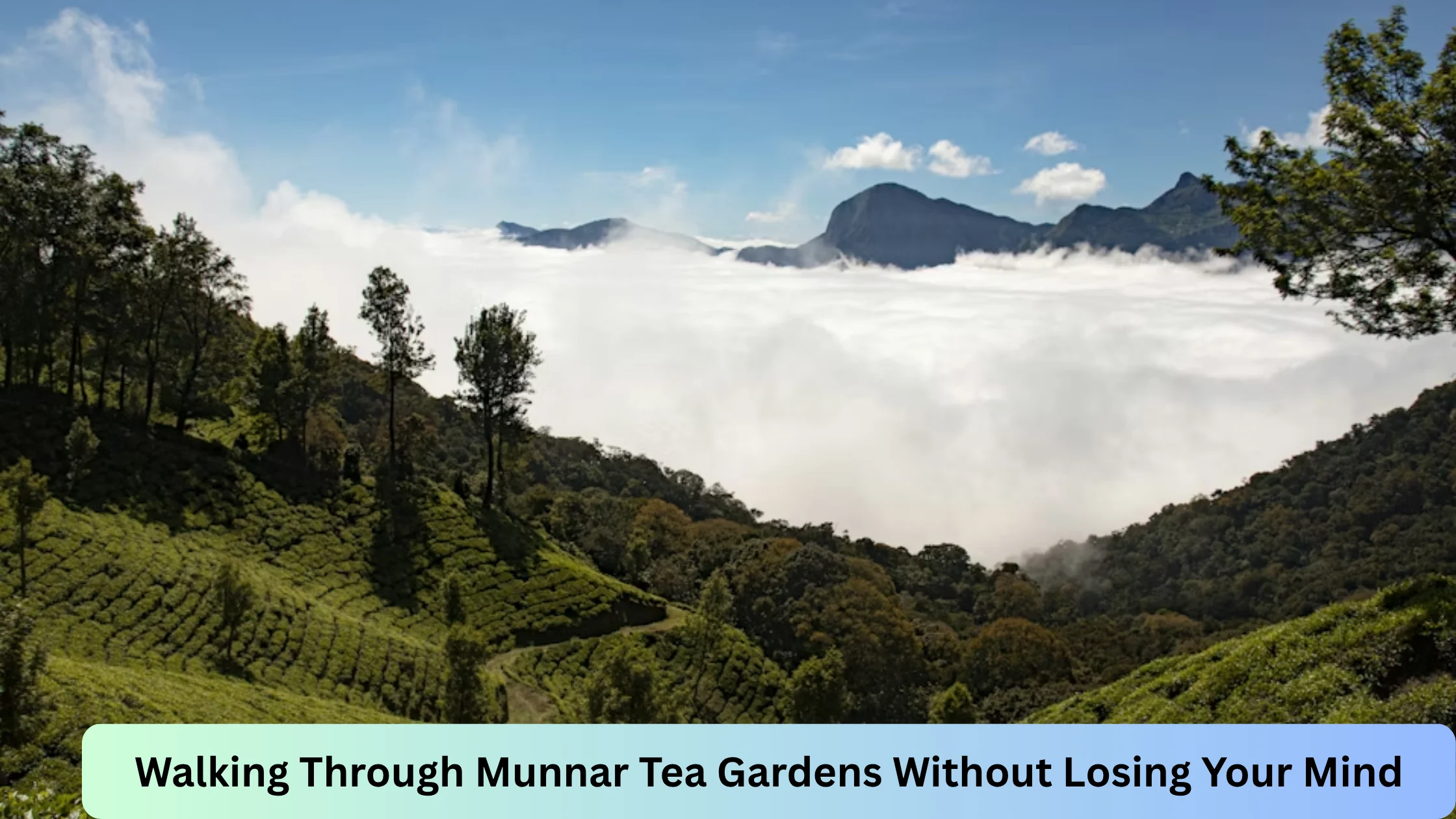
You think you’re going to walk through endless green hills, breathe fresh air, maybe have a cinematic moment where you question your life choices in a poetic way.
What actually happens? You’re squinting at slopes, wondering if you’re allowed to be there, and low-key stressed about slipping into a bush that looks soft but definitely isn’t.
This guide exists because most “tea garden” advice feels like it was written by someone who stood near a parking spot, took three photos, and left. We don’t do that here. This site is about actually doing the thing—and surviving it with your dignity mostly intact.
Give this half a day to a full day. You’ll walk, you’ll learn, and at some point you’ll realize tea is way more work than your morning cup suggests.
THE THING NOBODY ACTUALLY SAYS OUT LOUD
Tea gardens in Munnar are not a theme park.
There is no clear entrance gate. No “start here” sign. No helpful arrow saying “Instagram spot →”.
You just… show up. And suddenly you’re standing next to acres of tea bushes wondering if you’re allowed to exist there.
You are. Usually.
But here’s the part no one says:
You are walking inside someone else’s workplace.
That changes the vibe completely.
This isn’t a curated tourist space. It’s a functioning agricultural system where people are working real jobs. Early mornings? You’ll see workers moving fast, plucking leaves with a rhythm that looks casual but is anything but.
Midday? It gets quieter. Not because it’s peaceful. Because the work has already happened.
Most travel blogs skip this because it’s not “aesthetic.” But once you notice it, everything shifts. You stop treating the place like a backdrop and start paying attention.
And yes, you will feel slightly awkward at first. Like you’ve wandered into the wrong room at a party and no one told you.
That’s normal.
The trick is simple:
- Stay on visible paths
- Don’t step into dense sections randomly
- Don’t interrupt workers mid-task
Also, and this matters more than people admit—you don’t need to go deep into the plantation to have a good experience. Some of the best views are literally 20–30 steps off the road.
People overcomplicate this because they think “deeper = better.”
It doesn’t.
It just means you’re more likely to get lost or gently redirected by someone who works there.
The goal isn’t access. It’s awareness.
HOW THIS ACTUALLY WORKS AND WHY IT IS MORE COMPLICATED THAN ANYONE SAID
Here’s the structure nobody explains properly.
Tea gardens in Munnar fall into three categories:
- Open-access edges (what you see from roads)
- Semi-accessible areas (where walking is okay if you’re respectful)
- Restricted working zones (where you shouldn’t be unless guided)
The problem? There are no clear borders between them.
So you’re constantly guessing.
It’s like walking into a co-working space where half the desks are public and half are someone’s actual office. No signs. Just vibes.
Most people either:
- Stay glued to the road and miss everything
- Wander too far in and get uncomfortable
The middle ground is where the experience actually happens.
Let’s break down what matters when you’re walking through these spaces:
- Timing is everything
Morning (7–10 AM) is when you’ll see actual activity. Workers plucking leaves, moving through rows. By noon, it’s quieter and hotter. Same place, completely different feel. - The terrain is not your friend
These are not flat gardens. Slopes are real. Soil can be loose. After rain, it gets slippery fast. Wear shoes with grip unless you enjoy unexpected cardio. - The patterns are the point
Tea bushes are trimmed into neat shapes. When you look across hills, you’ll see waves of green lines. That’s not just pretty—it’s controlled growth for easier harvesting. - Not all “entry points” are obvious
Some of the best walkable areas are small side paths. You’ll miss them if you’re just driving fast between spots. - Guided walks exist for a reason
You can explore solo, sure. But a local guide explains things you would never notice. Like why only certain leaves are picked or how often bushes are trimmed.
And here’s the part people ignore:
Munnar isn’t one big tea garden. It’s a region with thousands of hectares of plantations. Kerala tourism data puts visitor numbers over a million yearly, but most people cluster in the same 4–5 spots.
So when you step slightly away from those, it gets quieter fast.
WHAT ACTUALLY HAPPENS WHEN YOU TRY THIS
You start confident.
You’ve seen photos. You’ve saved reels. You think you know what you’re doing.
Then you get there.
The road curves, suddenly you’re surrounded by tea bushes, and your brain goes, “Okay… now what?”
So you park. You step out. You walk 10 steps in.
And immediately, you’re hyper-aware of everything:
- The slope under your feet
- The silence
- The fact that this is not a tourist attraction with guardrails
When you actually do this, you slow down. Not because you planned to. Because you have to.
You start noticing things:
- The sound of leaves brushing when someone walks past
- The way sunlight hits different sections differently
- Workers moving faster than you expected
One thing that surprises most people? The smell.
It’s not strong like brewed tea. It’s lighter. Fresh. Slightly earthy.
And then there’s the pattern almost nobody talks about:
People either rush through in 10 minutes or stay way longer than planned.
There’s rarely an in-between.
If you treat it like a checklist, you leave quickly. If you let yourself just exist there for a bit, time stretches.
Also, small reality check—photos don’t capture the depth properly. Hills look flatter. Colors look less layered.
So yes, take photos. But also just stand still for a minute.
That’s where it hits.
THE ADVICE EVERYONE GIVES VERSUS WHAT ACTUALLY WORKS
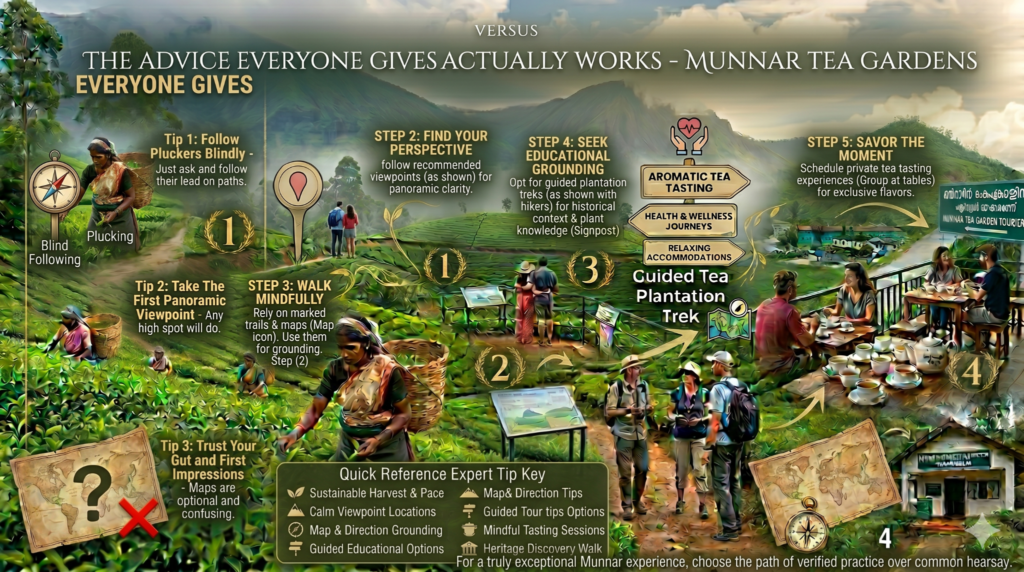
“Just explore freely.”
Sounds nice. Doesn’t work.
You’ll either stay too safe or accidentally wander into restricted zones. What works is controlled exploration—stick to visible paths and expand slowly.
“Visit all the popular spots.”
This is how you end up in crowds wondering why everything feels underwhelming. Popular spots are fine, but the magic is usually 5–10 minutes away from them.
“Go anytime, it’s always beautiful.”
Technically true. Practically misleading. Morning light changes everything. Midday flattens the landscape. Timing isn’t optional—it’s the difference between “nice” and “wow.”
“Spend a whole day inside one plantation.”
You won’t. It gets repetitive if you stay too long in one place. Variety matters more than duration.
“Guides are optional.”
They are. But skipping them means missing context. Without context, everything starts looking the same after a while.
The real approach is simple:
- One guided experience
- One self-exploration session
- One scenic drive
That mix keeps things interesting.
THE PART WHERE IT GETS PRACTICAL
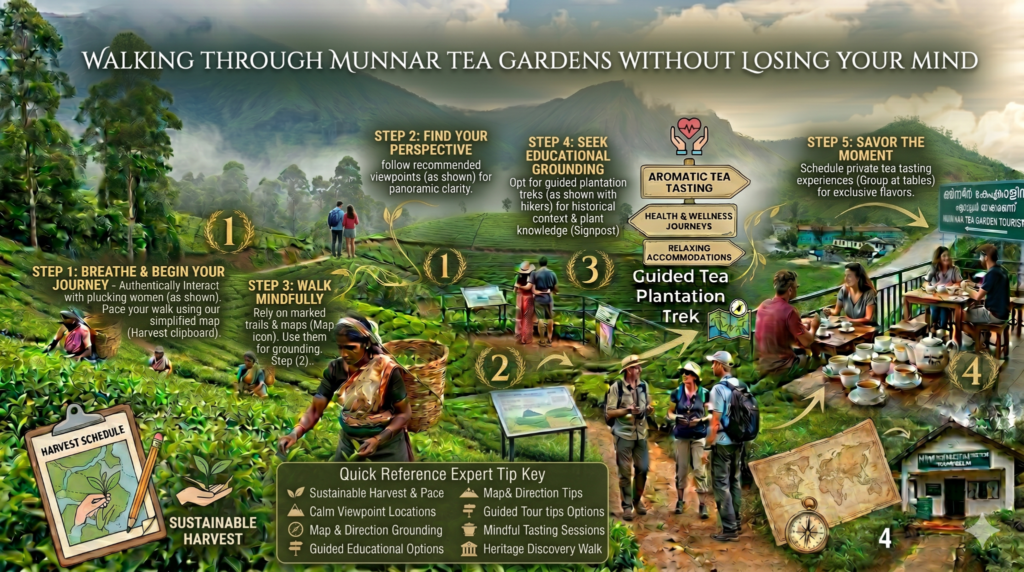
Start early. Like actually early. Aim to be in a plantation area by 7–8 AM. That’s when you’ll see movement and better light.
Pick one base area instead of jumping everywhere. Chithirapuram or Pallivasal work well. You spend less time driving and more time walking.
Walk in short bursts. 15–20 minutes per stop is enough. Then move. This keeps the experience fresh.
Use Google Maps, but don’t trust it blindly. Some of the best spots aren’t marked. If you see a safe place to stop, take it.
Talk to locals if you can. Even a quick “Is this area okay to walk?” can save you from awkward moments.
And wear proper shoes. Not optional. Slopes + loose soil = bad combo.
QUESTIONS PEOPLE ACTUALLY ASK (AND THE REAL ANSWERS)
Can you just walk into tea gardens in Munnar?
Sometimes yes, sometimes no. Roadside areas are usually fine. Deeper sections can be private. If it feels like a work zone, it probably is.
Is it safe to walk inside plantations?
Yes, if you stay aware. Stick to paths, avoid steep or muddy areas, and don’t wander too far without knowing where you are.
How much time do you actually need?
2–4 hours is enough for a solid experience. More than that, and it starts to feel repetitive unless you change locations.
Do you need a guide?
Not required, but helpful. A guide adds context. Without one, you’re mostly just looking at plants.
What’s the best time of day?
Morning. No debate. Better light, cooler weather, more activity.
Are tea gardens crowded?
Some are. Especially near main roads and popular spots. Move slightly away and it gets quieter fast.
Can you take photos freely?
Yes, but be respectful. Avoid pointing cameras directly at workers without permission.
SO WHERE DOES THIS ACTUALLY LEAVE YOU
Walking through tea gardens in Munnar is not a polished experience.
It’s slightly awkward at first. A bit confusing. Occasionally uncomfortable in a “am I supposed to be here?” way.
And then it settles.
You adjust. You slow down. You start noticing more than just “green hills.”
That’s the shift.
It stops being about getting the perfect photo and starts being about understanding what you’re actually looking at.
Is it perfect? No.
Is it worth doing properly instead of rushing through? Absolutely.
If you do one thing right—go early and give yourself time to just walk without a strict plan.
That alone changes everything.
CONCLUSION
If you made it this far, you’re already doing more than most people who show up, take three photos, and leave.
Walking through Munnar’s tea gardens isn’t about ticking a box. It’s about staying long enough for the place to stop feeling like a backdrop.
That usually takes a little patience.
And maybe better shoes than you planned.

Sunil Singh is a dedicated travel content writer and the founder of MunnarTeaGardens.in. He specializes in creating comprehensive, user-friendly guides on Munnar’s tea gardens, hill stations, and Kerala tourism. Drawing from the latest tourism trends, official sources, and visitor experiences, Sunil helps thousands of travelers plan safe and rewarding trips every year.